The Social Selling Index, or SSI, is a 0-to-100 score LinkedIn uses to measure how well you sell on the platform, long before any sales conversation starts. That the underlying method works shows up in LinkedIn's current Deep Sales research: sellers who work in a relationship- and insight-led way, exactly what the SSI rewards, are nearly twice as likely to beat their target as everyone else. Only 18% actually sell that way (Ipsos for LinkedIn, 2024). Most people still read the SSI as a personal grade. That's the mistake.
The real leverage isn't in one person's profile. It's in how a team performs together. This guide covers what the SSI actually measures, what counts as a good score, and why sales and marketing should run it as a shared system metric rather than an individual vanity number.
TL;DR: The Social Selling Index scores LinkedIn presence from 0 to 100 across four pillars. As an individual score it's nice. As a team metric it's a growth lever: content shared by employees reaches engagement rates around 14%, versus roughly 0.15% on brand-owned channels (SocialPubli, 2025). Manage the SSI as a team, instead of polishing one profile, and you capture reach your competitors leave on the table.
What Is the Social Selling Index?
The Social Selling Index is, in LinkedIn's own words, a metric from 0 to 100 that reflects how well someone establishes a professional brand, finds the right prospects, shares relevant content, and builds relationships on LinkedIn. Each pillar is worth up to 25 points, and they sum to the total: "Each of the above elements is assigned a value between one and 25, and the sum of all four elements results in a total SSI score between 0 to 100" (LinkedIn Sales Solutions, 2026). The score updates on an ongoing basis as you stay active, and it's free to view at linkedin.com/sales/ssi for any member, with no Sales Navigator subscription required.
The four pillars are:
- Establish a professional brand. A complete profile written from the buyer's point of view, not as a resume.
- Find the right people. Connect deliberately with your target audience, not with everyone.
- Share relevant content. Post and comment on useful content, and become visible.
- Build relationships. Develop and strengthen durable connections with decision-makers and peers.
Because every pillar contributes the same share, being strong in just one, posting constantly but never connecting deliberately, for example, caps your own score. The diagram below shows the structure:
Here is what that looks like in the actual dashboard. At linkedin.com/sales/ssi, LinkedIn shows your total score, the four pillars with their individual points, and where you rank within your industry and network:
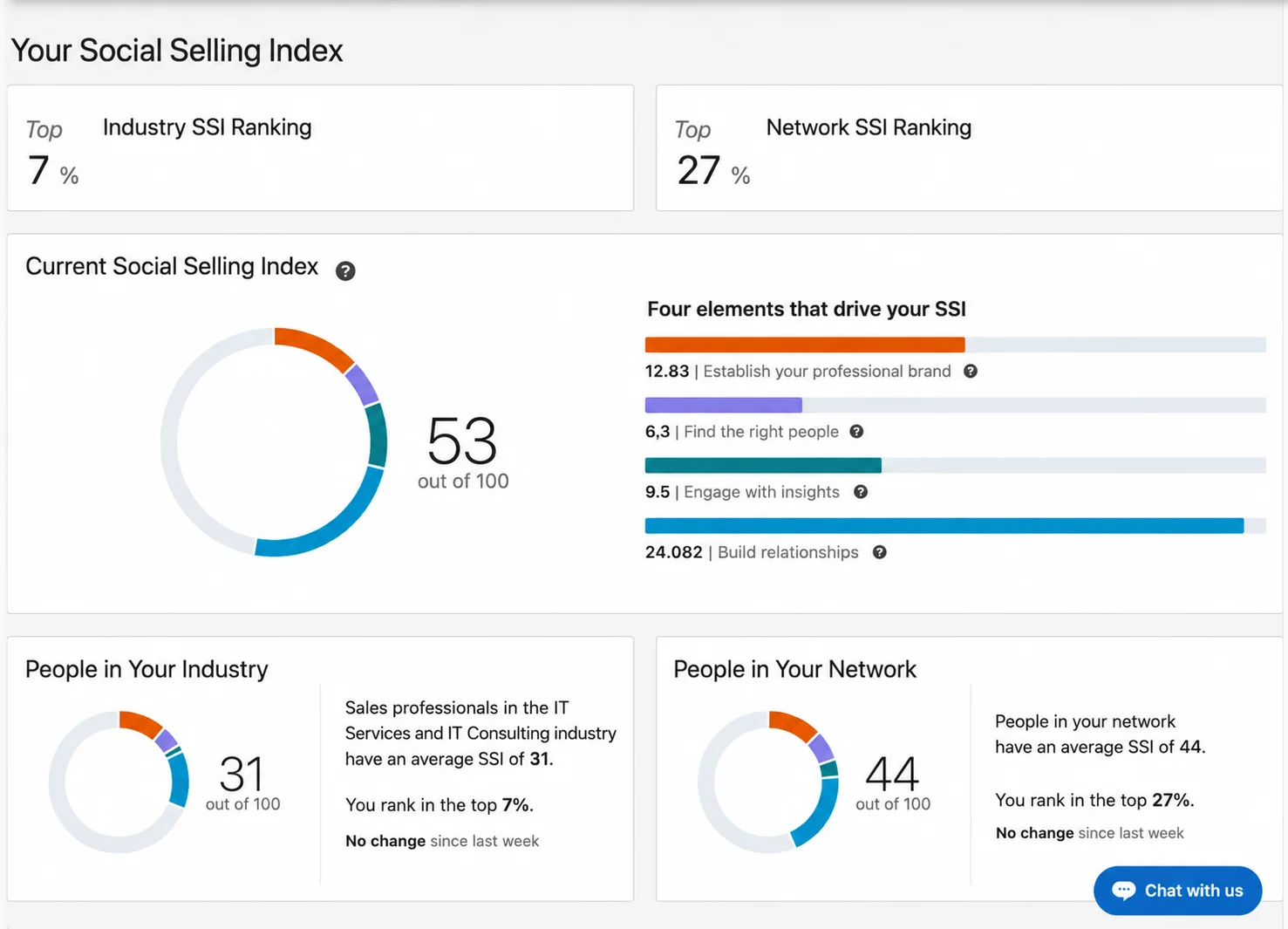
Citation: The Social Selling Index is a LinkedIn metric from 0 to 100 scoring four equally weighted pillars: professional brand, finding the right people, sharing relevant content, and building relationships. Each pillar is worth up to 25 points. It updates as you stay active and is free to view at linkedin.com/sales/ssi (LinkedIn Sales Solutions, 2026).
What Counts as a Good SSI, and What Does It Buy You?
LinkedIn doesn't publish a threshold for a "good" SSI. In practice, a score of 70 and up reads as strong and 80-plus as very strong, because most profiles sit well below that. The breakdown below is common-practice convention, not an official LinkedIn definition:
| SSI range | Practical reading |
|---|---|
| under 30 | weak, fundamentals missing |
| 30 to 69 | mid-range |
| 70 to 89 | strong |
| 90 and up | top tier |
More useful than the threshold is what the method delivers. The SSI measures relationship- and insight-led selling, and LinkedIn's current Deep Sales study quantifies the payoff: sellers who work this way are nearly twice as likely to beat their target as those who don't. At the same time, only 18% of sales professionals actually sell this way (Ipsos for LinkedIn, 2024). Raising your SSI is how you join that 18%.
Citation: LinkedIn publishes no official SSI threshold; in practice a score of 70 and up reads as strong. What matters more than the number is the method behind it: sellers who work in a relationship- and insight-led way, the way the SSI measures, are nearly twice as likely to beat their target, and only 18% sell this way (Ipsos for LinkedIn, Deep Sales Study, 2024).
Why Is the SSI a Team Metric, Not a Personal Grade?
Almost every conversation about the Social Selling Index centers on one person: your profile, your score, your four pillars. That's exactly where most companies leave the biggest lever untouched. A rep with an SSI of 95 reaches one network. Ten reps with an SSI of 65 reach ten networks, and combined they are far larger.
The numbers behind that team lever are clear, and they're current. Content employees share through their own profiles reaches engagement rates around 14% in advocacy programs, while brand-owned channels sit near 0.15%. On LinkedIn, those employee posts averaged nearly 900,000 impressions each in 2024, more than on any other platform (SocialPubli Employee Advocacy Benchmark, 2025). Personal profiles aren't just more likable than the company account, they're orders of magnitude more effective.
That leads to an uncomfortable truth for anyone running the SSI as a leaderboard between colleagues: pushing one profile from 90 to 95 has sharply diminishing returns. Pushing five profiles from 40 to 65 activates five previously silent networks. The SSI is most valuable as an average across a team, not as one person's personal best. Run it as an individual contest and you're optimizing the wrong number.
How that distributed visibility turns into actual conversations is something we broke down in detail in B2B lead generation in 2026, where social selling feeds the pipeline as an intent signal.
Citation: The Social Selling Index pays off as a team metric, not an individual score. Content employees share reaches engagement rates around 14% versus roughly 0.15% on brand channels, and averages nearly 900,000 impressions per post on LinkedIn (SocialPubli Employee Advocacy Benchmark, 2025).
How Do You Run the Four Pillars as a Team System?
If the SSI is a team metric, the four pillars have to be run as a system too, not as four chores every person tackles alone. The difference is operational, and it decides whether a team lifts the index or burns out chasing it.
Pillar 1, professional brand: consistency over lone wolves. Instead of everyone polishing a profile in isolation, marketing defines a shared profile template: visual style, positioning line, focus topics. The result is a recognizable presence across every profile, so a buyer sees a team rather than a grab bag. That pays off directly, since B2B buyers now vet vendors largely on their own before reaching out (6sense Buyer Experience Report, 2025).
Pillar 2, find the right people: shared ICP lists. Connecting isn't random, it follows the Ideal Customer Profile. When the team works the same target industries, roles, and regions, several profiles connect with the same buying committee from different angles. That's stronger than a single contact, because a typical B2B purchase now involves around eleven stakeholders (6sense Buyer Experience Report, 2025).
Pillar 3, share relevant content: one content engine feeds many profiles. This is the biggest efficiency gain. Not every person produces original content. Marketing builds an engine the team draws from, each adding their own voice. One post becomes many times the reach, without ten people starting from a blank page.
Pillar 4, build relationships: coordinated, not siloed. When a prospect comments on a colleague's post, the rep who owns that account knows about it and follows up. Relationships are handed off within the team instead of wasted in silos. That fits exactly how buying works now, where trust forms before the first conversation.

Citation: The four SSI pillars work harder as a team system than as solo effort: a shared brand template, shared ICP lists, one content engine for many profiles, and coordinated relationship handoffs. It fits today's B2B purchase, where around eleven stakeholders are involved and buyers self-direct roughly 60% of the journey (6sense Buyer Experience Report, 2025).
Who Should Own the Social Selling Index Inside a Company?
The most common question in practice isn't "how do I improve my SSI," it's an organizational one: who's actually responsible? In a lot of companies the SSI falls through the cracks. Marketing owns the company page, sales owns conversations, and the organic presence of individual employees belongs to no one. That gap is exactly why team social selling so often stalls before it starts.
The clean split divides by function in the system, not by person. Marketing runs the content engine and brand consistency, that's pillars 1 and 3. Sales owns relationships and deliberate connecting, pillars 2 and 4. The shared metric is the team's average SSI plus the reach it produces. That turns a vague "we should do more on LinkedIn" into a number with an owner.
This alignment pays off because of two current shifts in buyer behavior. First, B2B buyers self-direct roughly 60% of their journey before talking to sales, and 94% use AI assistants along the way (6sense Buyer Experience Report, 2025). If you're invisible during that quiet phase, you never make the shortlist. Second, trust travels through people, not logos: a person's own employer is the most trusted institution there is, with 75% trusting it (Edelman Trust Barometer, 2025). A visible, well-connected team serves both far better than cold outreach can.
That organic visibility is the structural alternative to cold outreach, whose limits we worked through in cold outreach alternatives for B2B.
Citation: The SSI stalls organizationally when no one owns it. The workable split: marketing runs the content engine and brand, sales owns relationships, and the shared metric is the team average. It fits today's buying: 60% of the journey runs without sales, and the employer is the most trusted institution at 75% (6sense, 2025; Edelman, 2025).
How Do You Improve Your Social Selling Index? A 90-Day Team Plan
You improve the Social Selling Index by working all four pillars: a complete, buyer-facing profile, deliberate connecting along your ICP, regular content, and active relationship-building. For a team, the move isn't a one-off push, it's a staged 90-day plan in three phases, ordered by impact. Trying to lift all four pillars for ten people at once gets you nowhere.
Phase 1 (days 0 to 30): baseline and profiles. Record each team member's current SSI at linkedin.com/sales/ssi and compute the average, that's your baseline. In parallel, bring every profile up to the shared brand template: a buyer-facing headline, a clear photo, focus topics. This phase lifts pillar 1 for the whole team without anyone posting daily.
Phase 2 (days 31 to 60): content engine and connecting. Marketing ships two to three shareable pieces a week, each with a clear point of view. Every team member connects deliberately along the shared ICP list, not at random. Now pillars 2 and 3 climb, and the first reach effects become measurable.
Phase 3 (days 61 to 90): coordinated engagement and scaling. The team visibly engages with target accounts' posts, hands off relationships in an orderly way, and scales only the content and formats that demonstrably drive interaction. This is where consistency pays, because the engagement edge of employee content over brand channels only shows up when people share regularly (SocialPubli Employee Advocacy Benchmark, 2025).
The point most teams miss: only 18% of sales professionals actually sell in a relationship- and insight-led way today (Ipsos for LinkedIn, 2024). That's not bad news, it's the opening. A team that commits to this method consistently stands apart from the other 82%. That coordinated, approval-based activation is exactly what 36leads' engagement automation runs, without anyone managing ten profiles by hand.
Citation: Improve the team SSI in three 90-day phases: baseline and profiles (pillar 1), then content engine and deliberate connecting (pillars 2 and 3), then coordinated engagement and scaling (pillar 4). Since only 18% of sales professionals sell in a relationship- and insight-led way, a consistent team stands clearly apart (Ipsos for LinkedIn, 2024).
What Doesn't the Social Selling Index Measure?
As useful as the SSI is for steering, it has clear limits, and knowing them honestly protects you from bad decisions. The SSI is LinkedIn's own metric. It measures activity and visibility on the platform, not revenue. A high score is an indicator of good conditions, not proof of closed deals.
Three points belong to an honest read. First, the SSI is a LinkedIn metric that rewards LinkedIn's own method, so it's not a neutral industry benchmark. Second, it also rewards activity that doesn't feed pipeline, like reach in the wrong audience. Third, no score replaces the actual conversation: the SSI gets you into view, the relationship closes the deal. Make the SSI your only target and you optimize the warm-up while mistaking it for the result.
This is exactly why the team view is the right one here too: what counts isn't a perfect individual score, it's whether the system of visibility, relevance, and relationships ultimately produces qualified conversations.
Citation: The Social Selling Index measures platform activity and visibility, not revenue. It's LinkedIn's own metric and rewards LinkedIn's own method, not a neutral benchmark. The SSI gets a team into a buyer's view, the relationship closes the deal, not the number.
Frequently Asked Questions About the Social Selling Index
What is a good social selling index?
LinkedIn publishes no official threshold. In practice, an SSI of 70 and up reads as strong and 80-plus as very strong, because most profiles sit below that. More telling than the number is the method behind it: sellers who work in a relationship- and insight-led way, the way the SSI measures, are nearly twice as likely to beat their target, and only 18% sell this way (Ipsos for LinkedIn, 2024). What matters most is your team's average.
How do I improve my social selling index?
The SSI rises when you work all four pillars: a complete, buyer-facing profile, deliberate connecting along your ICP, regularly sharing relevant content, and actively engaging with posts. The payoff is biggest at team level: content shared by employees reaches engagement rates around 14% versus roughly 0.15% on brand channels (SocialPubli, 2025).
Is the social selling index relevant for B2B?
Yes. B2B buyers now self-direct roughly 60% of their journey before they talk to sales, and 94% use AI assistants along the way (6sense Buyer Experience Report, 2025). Being visible and credible during that self-directed phase is what gets you considered, and that visibility is exactly what the SSI measures.
Can a team have a shared SSI?
LinkedIn assigns the SSI per person, not per team. But a team average can be tracked and managed, and that's the bigger lever. Employee content earns a multiple of the engagement brand channels do, averaging nearly 900,000 impressions per post on LinkedIn in advocacy programs (SocialPubli, 2025).
How often does the social selling index update?
The SSI reflects your most recent LinkedIn activity and updates on an ongoing basis. Go quiet for a while and the score drops. You can check it anytime at linkedin.com/sales/ssi.
Does checking your social selling index cost anything?
No. Your own SSI is free to view at linkedin.com/sales/ssi for any LinkedIn member, with no Sales Navigator subscription required.
Conclusion: Run the SSI as a System, Not a Leaderboard
The Social Selling Index is one of the few LinkedIn numbers a team can steer directly. Three things decide whether it moves anything:
- The SSI is a team metric. The team average beats one person's best, because ten mid-range networks reach more than one perfect profile.
- The four pillars are a system. Brand and content belong to marketing, people and relationships to sales, with one shared metric instead of diffuse ownership.
- Scale only what works. Baseline and profiles first, then content and connecting, then coordinated engagement, and you expand only what demonstrably drives interaction.
Run the SSI this way and you sell the reach your competitors leave sitting in private profile cosmetics. If you change one thing today, make it this: stop optimizing one profile, and start measuring your team's average.
36leads is a LinkedIn platform for B2B sales and marketing, built by Stanislav Soziev, that bundles content and coordinated engagement for an entire team in one system, with approval before every action. See how it works on the features overview. The entry point for visibility lives in the Content and Visibility plan, and the step to a conversation is one message away.
Frequently asked questions
LinkedIn doesn't publish an official threshold for a good score. In practice, an SSI of 70 and up reads as strong and 80-plus as very strong, because most profiles sit below that. More telling than the number is the method behind it: sellers who work in a relationship- and insight-led way, exactly what the SSI measures, are nearly twice as likely to beat their target, and only 18% sell this way ([Ipsos for LinkedIn](https://www.ipsos.com/en-us/linkedin-sales-solutions-deep-sales-study), 2024). What matters most is your team's average.

Stanislav Soziev
Founder at 36leads
Stanislav Soziev is the founder of 36leads, a B2B LinkedIn automation platform used by founders, SDRs, and marketing teams across DACH. He has spent the last decade shipping growth and sales systems, blending technical execution with go-to-market strategy. He writes about LinkedIn outbound, AI-assisted pipeline generation, and the mechanics of turning attention into qualified meetings.
LinkedInYour next 10 qualified leads start here.
Build your LinkedIn outbound, content, and AI conversations inside one cockpit. Nothing goes out without your approval.