67% of B2B buyers now prefer a rep-free buying experience (Gartner, 2026), yet most B2B lead generation playbooks were built for the opposite world: high-volume sequences, long prospect lists, and activity metrics that measure messages sent rather than pipeline earned.
The bottleneck isn't budget or headcount. It's system design. Most B2B teams already have enough channels, tools, and activity. What's missing is a predictable pipeline, because the system those tools run inside was never built for 2026.
This playbook covers LinkedIn automation logic, ICP precision, cost-per-qualified-lead benchmarks, and a 90-day pipeline blueprint with concrete KPI targets. It's built for B2B SaaS founders, SDR team leads, and revenue operations managers who need a repeatable system, not another channel recommendation. See how it plays out operationally in the 36leads LinkedIn automation workflow.
TL;DR: 67% of B2B buyers now prefer a rep-free buying process (Gartner, 2026). B2B lead generation scales in 2026 through Human-First Automation: automating context signals (LinkedIn intent, job changes, content interactions) rather than contact volume. The result is 2 to 4 times higher SQL rates with 60 to 70% fewer messages sent.
What Is B2B Lead Generation, and Why the Definition Changes Everything
B2B lead generation is not about finding contacts. It's the systematic process of identifying decision-makers who have both the fit and the moment to buy, then moving them from unknown to qualified pipeline. Only 27.23% of B2B marketers currently use any form of LinkedIn automation (Dux-Soup B2B Lead Generation Report 2026), despite 95.7% already using LinkedIn as a lead generation channel. That gap between platform adoption and system maturity is where the most available scaling opportunity sits in 2026.
Citation: Only 27.23% of B2B marketers use LinkedIn automation, despite 95.7% already using LinkedIn for lead generation (Dux-Soup B2B Lead Generation Report 2026). This 70-point gap between platform adoption and automation maturity is the primary scaling opportunity in B2B lead generation in 2026, not more channels or higher spend.
The confusion between "contact," "lead," and "pipeline entry" destroys more outreach ROI than any wrong tool choice. A contact is a data record in your CRM. A lead is a contact with documented interest and sufficient firmographic fit. A qualified pipeline entry additionally meets a timing or trigger criterion that signals real buying probability. Teams that conflate these three stages measure activity, not quality. An SDR books a meeting, the meeting gets counted as a "lead," but the prospect is from the wrong segment or has no budget. Automating this pattern doesn't scale pipeline. It shifts the problem faster.
The inbound versus outbound versus LinkedIn automation decision is also simpler than most frameworks make it: inbound generates demand through content and SEO, with lower CPL but a 6 to 18-month runway before measurable impact. Outbound initiates contact actively through email, phone, or LinkedIn, with fast feedback loops but declining reply rates in saturated channels. LinkedIn automation combines both logics: it uses intent signals from the network to trigger relevant outreach before initiating active contact. It's the only channel that pairs outbound speed with inbound relevance logic, and it's where outreach automation and campaign management produce compounding returns at scale.
MQL vs. SQL: The Metric That Separates Activity from Revenue
A Marketing Qualified Lead has documented interest and ICP fit. A Sales Qualified Lead additionally signals concrete conversational interest: a different resource investment, a different handoff, a different downstream cost. That distinction shapes resource allocation, headcount planning, and channel ROI calculations. 85.59% of B2B marketers use email for lead generation (Dux-Soup 2026), but very few track what proportion of those email leads become SQLs by channel. CPQL closes that gap: Cost per Qualified Lead equals CPL divided by SQL rate. A $50 CPL from a channel with a 1% SQL rate costs $5,000 per SQL. A $300 CPL from a channel that converts 8% costs $3,750 per SQL. Most CPL-focused benchmarks in the market don't account for that denominator at all.
According to the Dux-Soup B2B Lead Generation Report 2026, 95.7% of B2B marketers use LinkedIn as a lead generation channel, but fewer than 1 in 4 use automation on that channel. Most teams simply haven't defined the ICP precision layer that makes automation produce quality leads rather than activity volume. The gap is in system design, not tool availability.
Why Classic Outreach Logic No Longer Scales
73% of B2B buyers actively avoid or ignore outreach they consider irrelevant (Gartner, 2026). Adding more volume to irrelevant outreach burns sender reputation, trains prospects to ignore your domain, and produces the illusion of pipeline activity while SQLs stagnate.
Citation: 73% of B2B buyers actively avoid outreach they consider irrelevant (Gartner 2026). Human-First Automation produces a 4% SQL rate versus 0.5% for volume outreach, and a 3.5% meeting rate versus 0.3%, achieved with 60-70% fewer messages sent (36leads Q1 2026 internal benchmark).
The classic volume model worked when B2B segments were large and buyers were under-informed. In 2026, both conditions have reversed. Inbox saturation is at record levels, AI-generated lookalike sequences have made cold outreach indistinguishable from noise, and buyers complete 60 to 70% of their decision before contacting a vendor. The sales motion that worked in 2019 now produces diminishing returns at every KPI tier: reply rates, meeting rates, and SQL rates all decline as volume increases on unqualified lists.
The typical mistake compounds quickly: rising reply numbers get treated as success, so volume increases further. Two weeks later, SQL rate drops because more irrelevant replies are arriving. The model that treats more contacts as the solution to pipeline problems scales waste, not pipeline.
What Human-First Automation Actually Means
In setups that have shifted from volume outreach to quality outreach, one pattern repeats consistently: with a 60 to 70% reduction in messages sent, Positive Reply Rate and SQL rate increase by 2 to 4 times. Activity volume drops; pipeline return rises. The 36leads internal benchmark data from Q1 2026 makes this difference visible across four key performance indicators:
Human-First Automation (HFA) is the operational framework behind this shift. The logic: automate context signals, not contact volume. You don't automate the first message. You automate the identification process: who's currently active, who fits the ICP, which signal shows genuine interest. The human (SDR or founder) steps in only after a concrete signal has qualified the contact.
Speed-to-lead still matters inside this system: contacts reached within 5 minutes of showing intent are 21 times more likely to convert (InsideSales / Harvard Business Review). HFA closes that gap by automating the monitoring layer, so the human response arrives at the right moment rather than days later when the signal has gone cold.
According to 36leads Q1 2026 benchmark data, Human-First Automation produces a 4% SQL rate compared to 0.5% under volume outreach approaches, with a 3.5% meeting rate compared to 0.3%. These gains occur with fewer messages sent, not more, because outreach triggers are tied to intent signals rather than scheduled sequences applied to static lists.
How Does LinkedIn Automation Scale B2B Lead Generation?
LinkedIn drives 75 to 85% of all B2B social media leads (LinkedIn Business, 2025). But 95% of prospects are not ready to buy at any given moment (Edelman-LinkedIn Thought Leadership Impact Report 2024). Automation without an intent filter is cold outreach at scale. It costs more and converts less.
Citation: LinkedIn drives 75-85% of all B2B social media leads globally, with over 65 million decision-makers reachable on the platform (LinkedIn Business 2025). Yet 95% of prospects are not ready to buy at any given moment (Edelman-LinkedIn 2024). Signal-based automation identifies which 5% are ready, using intent signals rather than contact list volume.
LinkedIn is the only B2B channel where professional intent, company context, and direct reach coexist in one place. With over 1 billion members globally and more than 65 million decision-makers (LinkedIn, 2025), it provides target density that no other channel matches for B2B SaaS. The challenge is signal quality: knowing which of those billion profiles are worth contacting, and when.
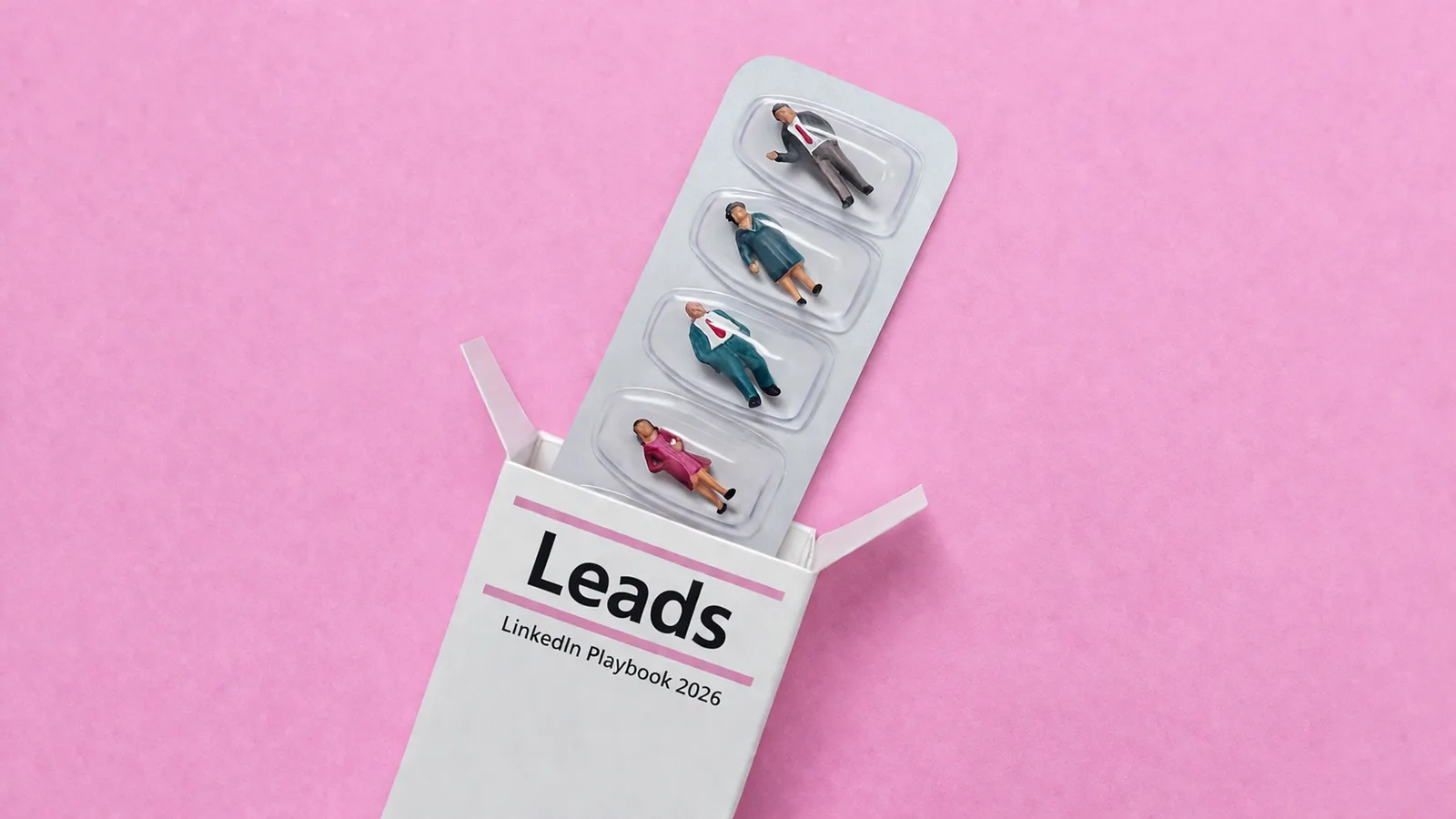
Social selling in B2B doesn't mean posting daily on LinkedIn. It means reading content interactions as intent signals and responding at the right moment. A prospect engages with one of your posts. You check firmographic fit and trigger signal. If both are present, a personalized sequence starts that references the post context. Visibility first, then contact. That's the operational core of Human-First Automation, and it's what distinguishes LinkedIn automation that produces SQLs from LinkedIn automation that produces connection request acceptance rates.
LinkedIn Sales Navigator serves as a precision tool, not an outreach tool. The most relevant ICP filters for global B2B SaaS: industry (SIC/NAICS codes aligned to your segment), company size (10 to 200 for SMB/mid-market, 200 to 1,000 for enterprise), geography, and change signals like active hiring activity, new leadership appointments, or GTM movement into new markets. This filter logic is the first step in the HFA chain. Contacts that don't fit the segment don't receive outreach, regardless of how low the marginal cost of an automated first message might be.
The Signal-to-Action Matrix
Not all LinkedIn signals carry equal weight. Acting on every signal with equal priority produces noise. The Signal-to-Action Matrix defines which signals trigger which actions, ranked by priority score from 0 to 100:
Profile views indicate awareness. Post likes suggest content resonance, but neither warrants outreach on its own. When someone comments on your content, the dynamic changes: they've entered your space and created a natural context for a follow-up message. Multiple interactions across posts over time indicate sustained interest, which is enough to trigger a personalized sequence. A job title change at an ICP-fit company is the highest-priority signal: the prospect is in transition, actively evaluating new tools and partners, and the outreach has a clear contextual reason.
LinkedIn outreach is legally permissible under multiple frameworks. Under GDPR (EU and UK), the legitimate interest basis applies to B2B direct marketing when three conditions are met: professional relevance of the contact to the offer, content relevance to their role, and documented data origin plus outreach rules. CAN-SPAM (US) and CASL (Canada, with implied consent for B2B) have their own requirements. What falls outside these frameworks in all jurisdictions: mass messaging without ICP qualification, and outreach without a recognizable professional context.
Human-First Automation is compliant by design: context signals (not mass data) form the outreach basis, which protects deliverability and brand trust simultaneously. A spam report on LinkedIn is not just a compliance problem. It's a deliverability event that affects every future sequence on that account.
According to LinkedIn Business data, the platform drives 75 to 85% of all B2B social media leads globally, with over 1 billion professionals reachable through it. Yet only 27.23% of B2B marketers currently use automation on this channel (Dux-Soup 2026). The gap between LinkedIn's reach and the automation adoption rate represents the largest underexploited scaling opportunity in B2B lead generation in 2026.
What Happens When You Automate the Wrong Audience?
The fastest pipeline improvement in any B2B outreach system is not better copy, better timing, or better tools. It's a more precise ICP. When the target account logic is wrong, every automation step amplifies the error. The more you scale, the more waste you produce, and the harder it becomes to separate signal from noise in your KPI data.
Citation: ICP precision is the fastest pipeline improvement lever in B2B outreach. Reducing a target segment by 40% through negative ICP criteria triples the SQL rate, because sequences now reach a smaller but significantly more relevant pool. B2B buyers use an average of 10 channels in their journey (McKinsey B2B Pulse 2024), making ICP accuracy critical across all touchpoints.
There are three ICP layers that compound in precision:
Layer 1: Firmographic Fit covers industry, company size, revenue range, and business model. This is the necessary minimum but not a sufficient qualification criterion on its own. Firmographic fit tells you who could be a customer, not who's likely to buy now.
Layer 2: Trigger Fit asks whether a signal is present that indicates actual buying readiness. Hiring for sales or marketing roles, GTM expansion into new markets, leadership changes in the relevant department, or funding events are all trigger signals. Outreach built on firmographic fit alone, without trigger signals, lands in wrong timing windows routinely. The prospect fits your ICP but doesn't have the problem today.
Layer 3: Buying Fit is the hardest layer: budget, decision authority, and a concrete occasion must coincide. It's rarely directly derivable from public signals, but trigger fit increases the probability considerably and is the layer that separates sequences with 1% meeting rates from sequences with 3 to 4% meeting rates.
Negative ICP: The Filter Most Teams Skip
The most underused lever in B2B lead generation is not "who do we include?" It's "who do we explicitly exclude?" Typical negative ICP criteria: companies below 10 employees (too early for the product), industries with 18-plus month sales cycles (misaligned for the team's quota rhythm), regions with structurally low ARPU, and buyer personas without decision authority (information gatherers who add meeting volume without adding pipeline).
Our finding: In ICP cleanup projects, one pattern repeats consistently. A team reduces its target segment by 40% by applying negative ICP criteria. SQL rate triples, because outreach sequences now reach a smaller but significantly more relevant pool. Less scaling, more precise scaling: that's the operational difference between "automate more" and "automate better." The team sends fewer messages, books fewer meetings, but closes more revenue per rep.
The bridge from automation output to pipeline entry requires three conditions: (1) the prospect fits on firmographic and trigger level, (2) the response signals concrete conversational interest (not just a polite reply), and (3) a defined handoff point to sales is documented in the CRM. Without all three, you have an activity number, not a pipeline entry. The distinction matters most at the end of the quarter, when "meetings booked" and "pipeline created" diverge.
Content signals serve as MQL-status indicators that most teams ignore. A post like, a profile view, or a comment from an ICP-fit account is a qualifying event that moves a contact from cold to MQL without any rep touch, when you have the ICP logic to interpret it correctly. B2B buyers use an average of 10 channels in their journey (McKinsey B2B Pulse 2024), meaning content engagement is a real signal, not noise, when the viewer fits the ICP.
ICP precision is the primary scaling lever in B2B lead generation. Negative ICP logic reduces waste and increases SQL rate without increasing volume. Three ICP layers applied in combination (firmographic, trigger, and buying fit) is the system design choice that makes automation produce pipeline rather than activity counts.
What Does B2B Lead Generation Actually Cost? CPL Benchmarks 2026
There's no meaningful single average CPL for B2B. But reliable channel ranges exist. And the real metric is not CPL at all. It's CPQL: Cost per Qualified Lead, calculated as CPL divided by SQL conversion rate. A $50 CPL from a channel that converts 1% to SQL costs $5,000 per SQL. A $300 CPL from LinkedIn that converts 8% costs $3,750 per SQL. The cheaper channel is more expensive where it counts.
Citation: LinkedIn self-service automation delivers CPL of $150-400 with SQL rates of 6-10% under proper ICP management, producing CPQL of $1,500-6,667 (Cognism/Cleverly 2026). CPQL (Cost per Qualified Lead = CPL divided by SQL rate) reveals that a $50 CPL from a 1% SQL-rate channel costs $5,000 per SQL, versus $3,750 from a $300 CPL / 8% SQL-rate channel.
LinkedIn CPL ranges from $15 to $350 depending on targeting precision and ICP quality (Cleverly LinkedIn Lead Generation Cost 2026). That range is wide enough to make CPL useless as a standalone metric. Two teams running LinkedIn outreach with different ICP definitions can see a 10x difference in CPL on the same channel. The variable is not the channel. It's the ICP precision layer.
Here are the 2026 USD benchmarks by channel, with estimated SQL rates and CPQL ranges:
| Channel | CPL Range | Avg. SQL Rate | CPQL Estimate |
|---|---|---|---|
| Inbound / Content | under $150 | 8-12% | $1,250-1,875 |
| LinkedIn Automation (self-service) | $150-400 | 6-10% | $1,500-6,667 |
| LinkedIn Automation (agency) | $300-800 | 4-7% | $4,285-20,000 |
| Email Cold Outreach | $150-500 | 2-5% | $3,000-25,000 |
| Phone Prospecting | $250-700 | 3-6% | $4,167-23,333 |
| Trade Show / Event | $1,500-3,500 | 15-25% | $6,000-23,333 |
Sources: Cognism B2B Benchmarks 2025, HubSpot Marketing Report 2025, Cleverly LinkedIn Lead Cost 2026.
Agencies deliver higher CPL with less control over segment logic and outreach quality. Onboarding takes 4 to 8 weeks, campaign handoffs create information loss between team and agency, and reporting overhead is structurally embedded in the engagement model. A self-service platform gives you full transparency over CPL per segment and allows fast iteration without agency briefings and approval cycles. Compare 36leads self-service platform pricing against the agency model cost structure above.
The CPQL framing also reframes where to invest in ICP work. Every dollar spent on ICP cleanup (removing companies below threshold, adding negative ICP criteria, refining trigger logic) directly reduces CPQL by increasing the SQL rate in the denominator. Most teams optimize spend on the CPL numerator, trying to find cheaper lead sources. The faster return is usually in improving the denominator: the same leads, better qualified, produce a lower CPQL without changing the channel budget.
According to Cognism, HubSpot, and Cleverly benchmark data, LinkedIn self-service automation delivers a CPL of $150 to $400 with SQL rates of 6 to 10% under proper ICP management, producing estimated CPQL of $1,500 to $6,667. This is consistently lower than agency-managed LinkedIn, comparable to inbound content on quality metrics, and significantly faster to produce results (days, not months).
KPI Stack and Your 90-Day Pipeline Blueprint
A three-tier KPI stack separates teams who have signals from teams who know what to scale. Without it, every month is a new hypothesis with no baseline to compare against. B2B buyers use an average of 10 channels in their buying journey (McKinsey B2B Pulse 2024). Without per-segment measurement, you can't tell which channel deserves more budget, which ICP layer is producing quality, or which sequence is driving meetings that close.
Citation: A three-tier KPI stack measures B2B outreach quality across Leading (Positive Reply Rate: floor 2%, target 6%, excellence 12%), Quality (SQL Rate: floor 1%, target 3%, excellence 6%), and Revenue (Win Rate: floor 10%, target 20%, excellence 25%). A Positive Reply Rate below 2% after 200 touches signals an ICP or messaging problem and should halt scaling (36leads Q1 2026).
The three tiers, with benchmark ranges built from 36leads Q1 2026 data:
Leading indicators measure early pipeline health: Positive Reply Rate (floor 2%, target 6%, excellence 12%). This tells you whether your ICP and message land, before the signal shows up in SQL numbers weeks later. A Positive Reply Rate below 2% after 200 touches means you have an ICP or message problem. Scaling volume at this point produces more noise, not more pipeline.
Quality indicators measure outreach efficiency: SQL Rate (floor 1%, target 3%, excellence 6%). This is the gate between activity and pipeline. An SQL Rate below 1% after a segment test means the segment definition needs work before Phase 3.
Revenue indicators measure actual business impact: Win Rate (floor 10%, target 20%, excellence 25%). This closes the loop between pipeline entry and closed revenue, and is the number that justifies or challenges every upstream investment in outreach, ICP, and tooling.
Phase-by-Phase Decision Gates
The 90-day blueprint runs in three phases, each with a decision gate before proceeding. The gates prevent teams from scaling problems rather than scaling wins.
Phase 1 (Days 1-30): Baseline and ICP Cleanup. Audit existing segments against the three ICP layers. Define negative ICP criteria. Set up tracking for Reply Rate and SQL Rate segmented by ICP definition. Run no new outreach volume without a clean baseline. Teams that skip this step repeat the same mistakes faster, and spend 90 days running reports that reveal what day 1 segment work would have prevented.
Phase 1 gate: Positive Reply Rate below 2% after 200 touches means ICP or message problem. Do not scale before resolving.
Phase 2 (Days 31-60): Sequence and Signal Tests. Test 2 to 3 variants, not 20 simultaneously. Focus: which signal trigger produces the highest Positive Reply Rate? Which sequence length correlates with meeting quality (not just meeting volume)? Aim for statistical significance per segment before drawing conclusions.
Phase 2 gate: SQL Rate below 1% after segment testing means restart ICP definition before Phase 3.
Phase 3 (Days 61-90): Scale Only Winning Segments. A segment earns the right to scale only when it shows stable quality improvement over two evaluation cycles. All other segments stay on test volume until their numbers confirm readiness. Premature scaling is the most common cause of CPQL blowouts.
Phase 3 gate: If CPQL exceeds channel benchmark by more than 2x, audit list quality before adding budget.
The governance rhythm that keeps this stack functional: weekly segment quality check (Positive Reply Rate), biweekly review of automation-to-sales handoff quality (meeting show rate, SDR feedback), monthly budget reallocation between segments based on CPQL per segment. Teams that skip this rhythm discover in the quarterly review that a winning segment stopped winning two months ago. Learn how 36leads supports global B2B teams in building this system.
Frequently Asked Questions About B2B Lead Generation
Citation: B2B cold outreach via LinkedIn is legally permissible under GDPR legitimate interest (EU/UK), CAN-SPAM (US), and CASL (Canada) when three conditions apply: professional relevance of the contact, content relevance to their role, and documented data origin with opt-out compliance. Mass messaging without ICP qualification falls outside these frameworks in all jurisdictions.
What is B2B lead generation?
B2B lead generation is the systematic process by which companies identify potential business customers, document their interest, and move them into qualified pipeline entries with real buying probability. The key distinction: a contact is a data record, a lead is a contact with interest and ICP fit, and a qualified pipeline entry also meets a timing or trigger criterion. Confusing these stages produces activity metrics that don't convert to revenue.
What does a B2B lead cost in 2026?
CPL alone is a misleading metric. Use CPQL (CPL divided by SQL rate). In USD, inbound leads typically cost under $150, LinkedIn self-service automation $150 to $400, phone prospecting $250 to $700, and trade show leads $1,500 to $3,500 (Cognism/Cleverly 2026). A $50 CPL from a 1% SQL-rate channel costs $5,000 per SQL. A $300 CPL from a channel with 8% SQL rate costs $3,750. The channel with the lower CPL is not always the cheaper channel.
When does LinkedIn automation make sense for B2B lead generation?
LinkedIn automation makes sense once ICP criteria are clearly defined and quality thresholds for segment entry are established. The minimum setup: firmographic fit with at least three hard criteria, at least one trigger signal as the outreach occasion, and a defined handoff point from automation to manual follow-up. Without this foundation, automation scales waste rather than pipeline. The 27.23% automation adoption rate among LinkedIn users (Dux-Soup 2026) reflects the system design gap more than a tool availability gap.
Is B2B cold outreach via LinkedIn legally permissible?
Yes, under appropriate legal frameworks. Under GDPR (EU and UK), the legitimate interest basis applies to B2B direct marketing when three conditions are met: professional relevance of the contact to the offer, content relevance to their role, and documented data origin plus outreach rules. CAN-SPAM (US) and CASL (Canada, with implied consent for B2B) have their own jurisdiction-specific requirements. Mass messaging without ICP qualification and outreach without a recognizable professional context fall outside these frameworks in all jurisdictions. For a full breakdown of what's permitted and what isn't across all B2B outreach channels in Europe, see B2B Cold Outreach Alternatives: What's Still Legal in Europe in 2026.
What is the difference between omnichannel and multichannel in B2B?
Omnichannel means all channels share a common data model and a shared handoff logic: the prospect moves through LinkedIn, email, and sales calls without information loss at each transition. Multichannel means multiple channels run in parallel without connection or shared context. B2B buyers use an average of 10 channels in their buying journey (McKinsey B2B Pulse 2024). Channel breaks without handoff logic destroy pipeline quality systematically, because each touchpoint loses the context that would make the next one relevant.
B2B Lead Generation in 2026: Build the System, Not the Channel List
B2B lead generation scales in 2026 through system design, not more touchpoints. Three conclusions from this playbook:
- Relevance beats volume. 73% of B2B buyers avoid irrelevant outreach. More messages without better segmentation scales waste, not pipeline.
- ICP precision beats sequence length. The fastest improvement comes from negative ICP logic and three defined qualification layers, not from longer sequences or more follow-up steps.
- Quality KPIs beat activity metrics. Reply Rate, CPQL, and SQL Rate per segment determine which segments earn the right to scale and which don't.
Human-First Automation runs on this logic: automate context identification, not contact volume. 36leads is built to implement this approach for global B2B teams, without agency overhead, list-purchase risk, or segment opacity.
Audit your lead generation system with 36leads.

Stanislav Soziev
Founder at 36leads
Stanislav Soziev is the founder of 36leads, a B2B LinkedIn automation platform used by founders, SDRs, and marketing teams across DACH. He has spent the last decade shipping growth and sales systems, blending technical execution with go-to-market strategy. He writes about LinkedIn outbound, AI-assisted pipeline generation, and the mechanics of turning attention into qualified meetings.
LinkedInYour next 10 qualified leads start here.
Build your LinkedIn outbound, content, and AI conversations inside one cockpit. Nothing goes out without your approval.