Most US guides answer the question the same way: cold email is legal if you follow the rules. Under CAN-SPAM that holds. You need honest headers and a working opt-out, plus a physical address in the footer, and you may send without asking first (15 U.S.C. § 7704, 2026). The UK gets to a similar place for companies: the consent rule in the Privacy and Electronic Communications Regulations is written for individual subscribers, not corporate ones (PECR, Regulation 22, 2026).
At the German border that playbook stops working. The first unsolicited marketing email to a German company already breaks the law, so the sequence tool you run at home turns into a liability the moment a Munich address enters the list. Austria goes further and bans the cold call too.
TL;DR: Cold email to businesses in Germany requires prior express consent under § 7 of the Act Against Unfair Competition; one email is enough for a cease-and-desist letter (BGH, I ZR 218/07, 2009). B2B cold calls are allowed only with presumed consent based on concrete facts about that company (BGH, I ZR 87/02, 2004). Austria bans both marketing calls and marketing emails without consent for businesses as well (§ 174 TKG 2021, 2026). Switzerland allows the call unless the number carries an asterisk in the directory and requires opt-in for mass email (BAKOM, 2026). On LinkedIn the text decides: a promotional message counts as electronic mail, a connection request without an offer does not.
Why is cold email legal in the US but not in Germany?
GDPR gets the blame, but the gap comes from an older EU directive that most US compliance guides never mention. Article 13 of the ePrivacy Directive requires prior consent for direct marketing by email to natural persons, and then leaves it to each member state whether legal persons get opt-in or opt-out protection (Directive 2002/58/EC, Art. 13(3) and 13(5), 2002). Some countries chose opt-out for companies. Germany chose the strictest reading and wrote it into competition law, not privacy law. Poland moved the same way in November 2024: Article 398 of its Electronic Communications Law requires consent before any commercial message by electronic means, B2B included (DMSales, Electronic Communications Law and B2B prospecting in Poland, 2024).
That choice matters for two reasons. First, the German rule sits in § 7 UWG, which any competitor, trade association or the recipient can enforce with a cease-and-desist letter, without waiting for a regulator. Second, it makes the GDPR "legitimate interest" argument irrelevant for the channel question: Article 6(1)(f) may justify processing a business contact's data, but it cannot make an email lawful that unfair-competition law prohibits (BVerwG, 6 C 3.23, 2025).
[UNIQUE INSIGHT] For a team selling into Europe, the question "EU or not" settles nothing. What decides the case is the recipient's country, the channel, and whether the message is promotional. A US playbook checks none of the three.
Citation Capsule: The ePrivacy Directive requires opt-in consent for marketing email to natural persons and lets each EU member state decide whether legal persons are protected by opt-in or opt-out (Directive 2002/58/EC, Art. 13, 2002); Germany implemented opt-in for businesses in § 7 UWG.
What is legal in Germany: email, cold calls or letters?
Email, SMS and messengers: consent first, no B2B exception
§ 7(2) no. 2 UWG lists advertising by automated calling machine, fax or electronic mail without the addressee's prior express consent as an unreasonable nuisance (§ 7 UWG, 2026). There is no carve-out for business addresses. The Federal Court of Justice settled the "one email is harmless" argument in 2009: a single unsolicited marketing email to a company is unlawful (BGH, I ZR 218/07, 2009).
The only statutory exception is existing customers. If a company obtained the email address in connection with a sale, it may advertise its own similar products, provided the customer has not objected and every message points to the right to object (§ 7(3) UWG, 2026). All four conditions apply together. A purchased list meets none of them, and neither does a scraped address or a badge scan from a trade show.
Cold calls: allowed with provable presumed consent
German law treats marketing calls to businesses differently from calls to consumers. A consumer must have given express consent; a business may be called if the caller can at least presume consent (§ 7(2) no. 1 UWG, 2026). The Federal Court of Justice defined presumed consent narrowly: concrete factual circumstances must suggest a material interest of the person called in this specific offer, and a directory listing is not one of them (BGH, I ZR 87/02, 2004).
The Federal Administrative Court tightened that in January 2025. A company had called dental practices on their publicly listed numbers and argued legitimate interest under GDPR. The court upheld the data protection authority's ban: those numbers exist for patients, not for marketing, and belonging to an industry does not create presumed consent (BVerwG, 6 C 3.23, 2025). In practice, "all CFOs in manufacturing" is not a reason to call. "This company posted three field sales openings in July and we sell sales training" is.
Postal mail: the one channel with no consent question
Direct mail to a business remains lawful unless the recipient has recognisably objected (§ 7(1) UWG, 2026). Slow and expensive, yes, but the consent question never arises.
Citation Capsule: In Germany, B2B marketing calls require presumed consent grounded in concrete facts about the company called (BGH, I ZR 87/02, 2004; BVerwG, 6 C 3.23, 2025), while a single marketing email without express consent is unlawful (BGH, I ZR 218/07, 2009).
Is LinkedIn outreach legal in Germany?
German courts treat messages sent through Xing, LinkedIn, Facebook or WhatsApp as electronic mail under § 7 UWG. The Higher Regional Court of Hamm decided this in a case where a service provider used the messaging functions of Xing, LinkedIn and X to pitch brokerage services to people who had listed property online: promotional messages through these services need prior express consent, and a general interest on the recipient's side does not replace it (OLG Hamm, 18 U 154/22, 2023).
Being connected does not help either. In November 2025 the Düsseldorf local court ruled against an IT provider that had sent two marketing emails to a company and argued that an indirect LinkedIn connection with its managing director amounted to consent. It did not: no express, presumed or implied consent existed (AG Düsseldorf, 23 C 120/25, 2025).
The rulings stop short of banning every LinkedIn contact. § 7 UWG covers advertising. No court has yet classified a connection request as advertising when it names a genuine professional reason and contains no product or price, and no supreme court has drawn that line either. The broad definition of advertising can still catch a request that visibly serves nothing but sales. One short rule protects against both mistakes:
- No offer in the first message. No product, no pricing. Only the reason this person belongs in this network.
- A real, documented reason per contact. A role and a trigger, such as a job posting or a talk. If the reason does not fit in one sentence, it does not exist.
- A human approves every message before it goes out. The statute does not demand it. Without approval, though, no process keeps a contact request from turning into advertising over time. 36leads is built on that principle: the sales rep drafts, a person on your team approves.
Citation Capsule: Promotional messages via LinkedIn, Xing, Facebook and WhatsApp count as electronic mail and require prior express consent in Germany (OLG Hamm, 18 U 154/22, 2023); a LinkedIn connection is not that consent (AG Düsseldorf, 23 C 120/25, 2025).
How do Austria and Switzerland differ from Germany?
Austria: stricter than Germany on every channel
Austria regulates outreach in its Telecommunications Act rather than in competition law, and the wording is blunt: calls for advertising purposes need the user's prior consent, and electronic mail including SMS may not be sent for direct marketing without the recipient's prior consent (§ 174(1) and (3) TKG 2021, 2026). Germany's presumed consent route for businesses does not exist there. The Austrian Chamber of Commerce confirms the consent requirement applies to all recipients and lists administrative fines of up to EUR 100,000 for unsolicited calls and up to EUR 50,000 for unsolicited emails, enforced by the Fernmeldebüro (WKO, 2024).
What remains in Austria: the existing-customer exception for email (five conditions, including a check against the national opt-out list), postal mail, and contact without promotional content.
Switzerland: liberal on the phone, opt-in for mass email
Switzerland is outside the EU and regulates through its own Unfair Competition Act. Mass advertising by email, SMS, fax or phone has required consent since 1 April 2007; the sender must be identifiable and the recipient must get a free, simple way to refuse further messages. Customers who gave their address at purchase are exempt (BAKOM, 2026).
For calls, the asterisk rule has applied since 1 January 2021: marketing calls are unlawful to numbers marked with an asterisk in the directory or not listed at all, unless a business relationship exists (Steiger Legal, 2020). A listed company number without an asterisk may be called. Prosecutors act on complaint, and an intentional breach of Art. 3 UWG carries up to three years' imprisonment or a monetary penalty (Steiger Legal, 2020).
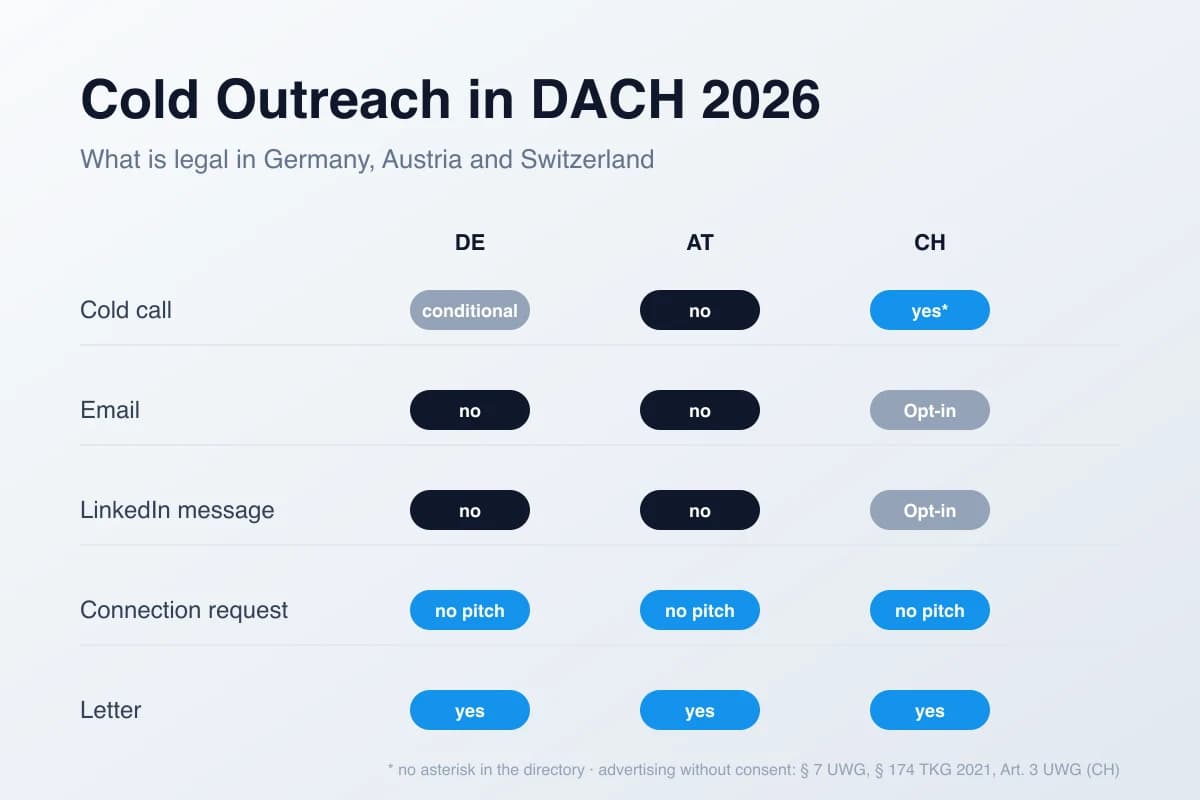
The DACH matrix
| Channel | Germany | Austria | Switzerland |
|---|---|---|---|
| Cold call (B2B) | Allowed with presumed consent, documented per contact (§ 7(2) no. 1 UWG) | Prohibited without prior consent (§ 174(1) TKG 2021) | Allowed if the number is listed without an asterisk, or a business relationship exists (Art. 3(1)(u) UWG) |
| Email, SMS | Prohibited without express consent; existing-customer exception (§ 7(2) no. 2, (3) UWG) | Prohibited without consent; existing-customer exception with opt-out list check (§ 174(3), (4) TKG 2021) | Mass advertising only with opt-in, sender ID and unsubscribe (Art. 3(1)(o) UWG) |
| LinkedIn message with an offer | Electronic mail, prohibited without consent (OLG Hamm 18 U 154/22) | Electronic mail, prohibited without consent | Opt-in as mass advertising |
| LinkedIn connection request, no offer | Not ruled to be advertising; safe only with a genuine reason and no pitch | Same | Same |
| Postal mail | Allowed absent a recognisable objection | Allowed | Allowed |
| Sanction (B2B) | Cease-and-desist, injunction, contractual penalty; the EUR 300,000 fine applies to consumer calls (§ 20 UWG) | Administrative fine up to EUR 100,000 (calls), EUR 50,000 (email) | On complaint: up to three years' imprisonment or monetary penalty (Art. 23 UWG) |
Citation Capsule: Austria prohibits marketing calls and direct-marketing email without prior consent for consumers and businesses alike (§ 174 TKG 2021, 2026); Switzerland permits marketing calls to listed numbers without an asterisk and requires opt-in for mass email (BAKOM, 2026).
What happens if you break the rules: Abmahnung or fine?
The number most guides quote is the wrong one. The Federal Network Agency imposes the EUR 300,000 fine in § 20 UWG for marketing calls to consumers without express consent (§ 20 UWG, 2026). For B2B outreach the exposure looks different and arrives faster: a competitor or the recipient sends an Abmahnung, a formal cease-and-desist letter demanding an undertaking backed by a contractual penalty. Every further breach then triggers that penalty.
The cost follows the value courts assign to the dispute. The Berlin Court of Appeal values the first unsolicited marketing email at EUR 3,000 and each further one from the same sender at EUR 1,000 more; after a warning letter, no discount applies (KG, 5 W 6/23, 2023). Legal fees per letter land in the high three to four figures, and the undertaking closes the channel for good.
Enforcement is rising again. After peaking at 79,702 complaints in 2021, written complaints to the Federal Network Agency about unlawful marketing calls fell to 34,714 in 2023 and have risen since: 37,561 in 2024 and 39,842 in 2025 (Bundesnetzagentur, 2026). Fines in 2025 totalled EUR 1.099 million across 13 proceedings, and for the first time the agency sanctioned breaches of the consent documentation duty that has applied since October 2021.
For comparison, the US regime is expensive in a different way. CAN-SPAM does not require consent, but the Federal Trade Commission can seek civil penalties of up to USD 53,088 per non-compliant email (Federal Register, FTC civil penalty adjustments, 2025). Germany's exposure is smaller per message and much easier to trigger.
Citation Capsule: The German Federal Network Agency recorded 39,842 written complaints about unlawful marketing calls in 2025, six percent more than in 2024, and imposed fines of EUR 1.099 million (Bundesnetzagentur, 2026).
The compliance checklist for teams selling into DACH
In all three countries the sender carries the burden of proof. If a German team relies on presumed consent for a call, it must be able to show the concrete facts; if it claims express consent, it must have it documented. Since 2025 the Federal Network Agency also sanctions missing documentation (Bundesnetzagentur, 2026). Before a team touches its first DACH contact, three things belong in the CRM:
- Data source per contact. Where the number, address or profile came from, and on which legal basis it is stored.
- A material reason per contact. One sentence explaining why this company plausibly wants this offer. Without that sentence there is no presumed consent.
- A system-wide opt-out flag. One objection covers every channel and every colleague.
Then decide channels by country, not by region. Email sequences stay switched off for Germany and Austria unless consent exists. Calls are an option in Germany with a documented reason, off in Austria, and subject to an asterisk check in Switzerland. LinkedIn works everywhere on one condition: the first message gives a reason and skips the pitch.
[ORIGINAL DATA] The demand side confirms the shift. German searches for "kaltakquise b2b erlaubt" (is B2B cold outreach allowed) tripled within a year, from 110 to 320 per month, while the blunter "kaltakquise verboten" (cold outreach banned) is the largest but declining query at 590 (DataForSEO Labs, retrieved September 2026). The question is moving from "is it banned" to "what exactly may I do".
Teams that want the cost side of the same decision, meaning which outreach routes scale in Europe without legal exposure and what they cost, will find the comparison in B2B Cold Outreach Alternatives. How ICP precision and data provenance fit together operationally is covered in B2B Lead Generation in 2026. The approval mechanism is described in AI SDR: what it does, what it costs, where it fails.
Citation Capsule: In Germany the sender bears the burden of proving consent to marketing calls or emails, and a documentation duty has applied since October 2021, first sanctioned by the Federal Network Agency in 2025 (Bundesnetzagentur, 2026).
Conclusion: three variables, one rule
Cold outreach into German-speaking Europe is still possible, within limits. It depends on the channel (calls defensible, email not), on the country (Germany tolerates, Austria prohibits, Switzerland checks for an asterisk) and on the content (a reason or a pitch). A team that can answer and document those three variables per contact works safely. A team that cannot is on its way to its first Abmahnung.
The one rule that holds in all three countries: no offer in the first message, a genuine reason per contact, a human approval before anything goes out. If you change one thing this quarter, put the approval into the process instead of trusting that nobody will slip. The pricing page shows how that works with a sales rep who drafts and lets you approve.
Sources
- § 7 UWG, Unzumutbare Belästigungen, German Act Against Unfair Competition (gesetze-im-internet.de), retrieved 2026-09-01
- § 20 UWG, fines (gesetze-im-internet.de), retrieved 2026-09-01
- BGH, judgment of 5 Feb 2004, I ZR 87/02 (dejure.org), retrieved 2026-09-01
- BGH, judgment of 20 May 2009, I ZR 218/07, E-Mail-Werbung II (dejure.org), retrieved 2026-09-01
- BVerwG, judgment of 29 Jan 2025, 6 C 3.23, case note by Kanzlei Kotz, retrieved 2026-09-01
- OLG Hamm, order of 3 May 2023, 18 U 154/22 (medien-internet-und-recht.de), retrieved 2026-09-01
- AG Düsseldorf, judgment of 20 Nov 2025, 23 C 120/25 (medien-internet-und-recht.de), retrieved 2026-09-01
- § 174 TKG 2021, Unerbetene Nachrichten, Austrian Telecommunications Act (RIS), retrieved 2026-09-01
- WKO, E-Mail- und Telefonwerbung nach dem Telekommunikationsgesetz, 15 Oct 2024, retrieved 2026-09-01
- BAKOM, Wann ist der Massenversand erlaubt? (Swiss Federal Office of Communications), retrieved 2026-09-01
- Steiger Legal, Telefonmarketing Schweiz 2021, 30 Nov 2020, retrieved 2026-09-01
- Bundesnetzagentur, press release of 26 Jan 2026, retrieved 2026-09-01
- Bundesnetzagentur, press release of 20 Jan 2025, retrieved 2026-09-01
- Bundesnetzagentur, press release of 19 Jan 2024, retrieved 2026-09-01
- Bundesnetzagentur, press release of 13 Jan 2023, retrieved 2026-09-01
- KG, orders of 4 May and 20 Jun 2023, 5 W 6/23, dispute value for marketing emails (IWW), retrieved 2026-09-01
- 15 U.S.C. § 7704, CAN-SPAM requirements (Cornell LII), retrieved 2026-09-01
- Federal Register, FTC Adjustments to Civil Penalty Amounts, 17 Jan 2025, retrieved 2026-09-01
- PECR 2003, Regulation 22 (legislation.gov.uk), retrieved 2026-09-01
- Directive 2002/58/EC, Article 13 (EUR-Lex), retrieved 2026-09-01
- DMSales, Electronic Communications Law and B2B prospecting in Poland, 1 Nov 2024, retrieved 2026-09-01
- DataForSEO Labs, German search volume data, retrieved 2026-09-01
This article is not legal advice. For specific cases, consult a lawyer qualified in the recipient's jurisdiction.
Frequently asked questions
No, not without prior express consent. Section 7 of the German Act Against Unfair Competition (UWG) treats advertising by email, fax or automated calls without the recipient's prior express consent as an unreasonable nuisance, and the rule applies to business recipients as well as consumers ([§ 7 UWG](https://www.gesetze-im-internet.de/uwg_2004/__7.html), 2026). The Federal Court of Justice held that a single unsolicited marketing email to a company is enough to breach it ([BGH, I ZR 218/07](https://dejure.org/dienste/vernetzung/rechtsprechung?Gericht=BGH&Datum=20.05.2009&Aktenzeichen=I+ZR+218%2F07), 2009).

Stanislav Soziev
Founder at 36leads
Stanislav Soziev is the founder of 36leads, a B2B LinkedIn automation platform used by founders, SDRs, and marketing teams across DACH. He has spent the last decade shipping growth and sales systems, blending technical execution with go-to-market strategy. He writes about LinkedIn outbound, AI-assisted pipeline generation, and the mechanics of turning attention into qualified meetings.
LinkedInYour next 10 qualified leads start here.
Build your LinkedIn outbound, content, and AI conversations inside one cockpit. Nothing goes out without your approval.